Categories
Uncategorized

Toxic Vibes

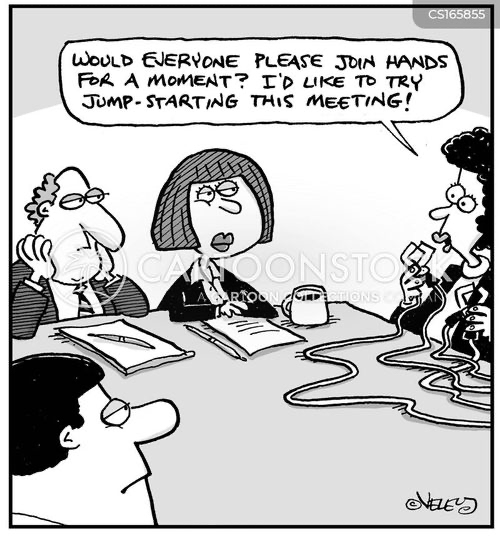
In chapter 11 we learn about the key term called climate. Climate is introduced under cultural perspective and is defined as the workplace atmosphere. It affects how employees feel and their overall mood. The cartoon above is the perfect example of what climate in the workplace can be. It represents a tense work environment where one of the females wants to speed up the meeting. This could be caused due to poor leadership or lack of communication. When the workplace climate is toxic it leads to less motivation and morale. You can see in the cartoon that the other employees are not amused with the female who’s trying to shock them into getting the meeting over with. 

This relates to my personal experience of working in a negative environment. When I used to work as a birthday party hostess my manager made the work environment quite negative a lot of the time. All of the employees had a difficult time working with her. She more often than not criticized instead of praised leaving us to feel discouraged. Even when we did our best and went above and beyond to make the clients happy she still found something to criticize. Overall, this made the workplace climate toxic and many employees left one by one. 
Categories
Uncategorized

Permission to speak

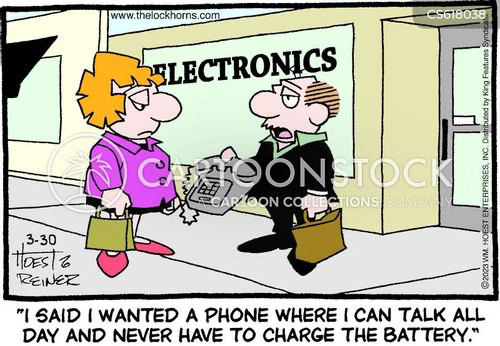
In chapter 10, we learn about the term called power. Power affects how we understand others’ messages and our confidence in speaking up. The cartoon seen above can be interpreted many different ways. Whether it is a husband and wife or a boss and employee it is clear that the woman in the cartoon has the power. She wants a phone similar to what we have now but there’s no such thing as not having to charge the battery. The man is stressed and exhausted, probably from running around trying to find her the best option. Even though her demands are not obtainable he still never speaks up or back to her. It’s clear that she has a strong hold on him. 

This cartoon relates to my personal experience when my old manager used to constantly scream into our head piece demanding for us to work faster. In most cases it was not possible to work any faster but from her viewpoint of sitting in her perfectly air conditioned office she disagreed. All of the coworkers knew that if we were to say something the boss would support her over us. This was a clear power trip that many of us did not like. Even though more than once I wanted to tell her to stop screaming, I kept my mouth shut until the last month I was working at the job. Towards the end I found my voice and spoke up against the things that I disagreed with.  

Categories
Uncategorized

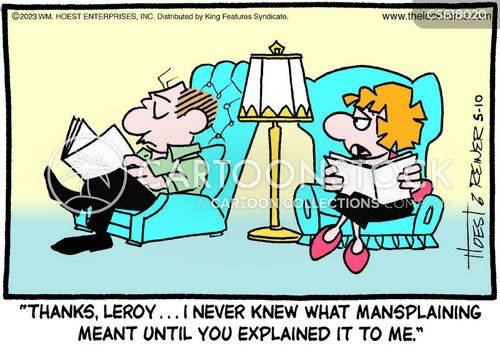
“Let me explain”

In chapter 13, we are introduced to the term gender communication. Gender communication relates to how we as individuals talk to each other and about each other. The cartoon above is the perfect ironic example of what mansplaining is. You can see how the couple is engaging in a conversation about mansplaining. The woman clearly does not know what it is and who better to explain than a man. I think it’s pretty funny because this cartoon depicts the exact behavior that it’s defining. Clearly the man has no idea that he’s mansplaining which leads us to think how unconscious bias affects communication between men and women. 

I remember a time where I was at work and I was tasked to clean up with a couple other of my coworkers. One of my coworkers never vacuumed before which blew my mind so I had to show and explain it to her. One minute later my male coworker did the exact same thing to her and corrected her on how to vacuum when she was doing it perfectly fine. When I explained it to her he was standing right in the room. I don’t think he realized that he was mansplaining but it really opened up my eyes to how unconscious it can be.

Categories
Uncategorized

Power

In Chapter 12 we are introduced to the key term called privilege. Privilege is what makes a certain group more powerful over another. It is referred to as a knapsack that can’t be seen by others but gives you an advantage. This cartoon is the perfect example of what privilege can look like. One man is telling the other man how he shouldn’t be viewed as a bad or dirty business man who has no values. But since he is the president of the board he’s the one who has the most power/privilege. It’s already kind of unspoken that a director has the most power but here it is being made even more clear.

This cartoon reflects a personal experience I once had at my past job. I used to work as a front desk receptionist and when I first started the manager had this big power trip. I would be asked to do all these different things that were way past the requirements of my job. Since I needed the job I ended up doing them but the power trip was so clear. The only time that I wasn’t being bossed around by the manager was when the owner of the business came. In a way we can see how the power of the boss is invisible but still known due to the reaction of the manager when she came in. 

Categories
Uncategorized

Who am I?

In Chapter 9 we learn about the key term called self-disclosure. As mentioned in the chapter Self disclosure is information that is not known about overselves that is revealed to others. The cartoon above is a great example of what self disclosure is. The woman appears at a job interview and is asked to talk about herself. She mentions her two traits that she’s strong and has passion which we can’t see by just looking at her. Self disclosure is a deep topic that requires many to dig deep down and search for who they really are. 

This topic relates to my personal life because like many people I’ve been at a couple job interviews and also had to answer the questions interviewers ask to get to know you. I think that the phrase “tell me about yourself” and the question “how would you describe yourself?” are two of the most overrated things to ask. Ultimately interviewers always hear the same thing from the people they talk to. I always expect to be asked this and struggle to think past the basics of “hardworking” or “determined”. Even at my last job interview I knew the question was coming and practiced it in my head before the interview and still ended up saying “hardworking” as one of my responses.

Categories
Uncategorized

Environment

In Chapter 3 Types of Nonverbal Communication we learn about the term “environment“. Environment is defined as nonverbal acts that we exhibit through the area that surrounds us. Whether it’s our home, work space, or car the environment reflects a specific meaning and can be interrupted differently by each person that sees it. This cartoon shows a polluted ocean and two men having a conversation about how they will be blamed for making such a mess. In their eyes it’s not their fault based on the way they’re speaking but in reality it is. The cartoon depicts the term environment because of how the space around the two men is used. Based on what can be seen we know that these two company workers are at fault since they are polluting the ocean while making money for their companies. 

This cartoon relates to my life through the way my environment looks at home. I am not embarrassed to admit that my room more often than not is messy. To me it’s a functional mess, that serves its own purpose. To the people that view it they feel as if it is too messy. In reality it’s not that messy. Each person that may see it has its own interpretation. 

Categories
Uncategorized

I don’t understand!

In Chapter 2 Rule Governed we learn about a term called Syntactics which is the study of the meaning behind language and the way language is arranged. This cartoon is an example of Syntactics and how important the way we speak is and the meaning hidden behind language. To be honest this is a quite funny cartoon because it’s kind of ironic that they’d have to meet anonymously when there’s nothing wrong behind the way they speak. Well at least nothing that has to be a secret. In this context the message behind the way they are speaking is projected to be wrong. This cartoon displays syntactics perfectly because the man speaking is mixing up the words which causes it to be difficult to understand him. Each word has its own meaning but when it’s put together it creates an entirely different meaning. 

This cartoon relates to my personal experience because my language sometimes becomes scrambled, also making it difficult for others to understand. This happens often after a long day at work and I’m very tired. This also happens when I try to speak quickly and my brain says the words much faster than my mouth. I think it’s funny but sometimes it can be embarrassing if it happens in front of my boss.

Categories
Uncategorized

Believe it or not!

In Chapter 4 The Classical Period we learn about the termmeans of persuasion” which include logos, ethos, and pathos. This cartoon is a great example that relates to chapter 4. Logos refers to the logic behind someone’s reasoning. This is represented with the first image of the doctor introducing what field he works in. Ethos refers to what makes a person credible. This is displayed through the second image where since we now know he is a doctor in dental surgery his recommendation of the Klean toothpaste is valid. Pathos is what appeals to the audience and is represented in the third image where the doctor claims the toothpaste keeps your teeth clean. 

This cartoon relates to my life because I have also been convinced by a dentist to get something that I didn’t really need. I used to have such sensitive teeth and the dentist I was going to recommended flurioide toothpaste. All toothpaste has fluoride for the most part but the one she was offering was a higher dose which supposedly would help my teeth. I bought the toothpaste from her for $25 and got played. It didn’t help any more than plain Sensodyne did. Since she was a cosmetic dentist I believed her and fell for “means of persuasion”.

Categories
Uncategorized

What did you say?

In Chapter 1 we are introduced to the topic of communication. The key term Linear Model of Communication encompasses four main parts: sender, channel, receiver, and noise and is introduced in the defining communication section. This image relates to the chapter by depicting the Linear Model of Communication. The male figure is expressing his love which is the message and he’s the sender while the receiver is the female figure. The message is sent through a verbal channel. In the background you have music playing which serves as the noise aspect of the model and interferes with what the female hears. 

This image relates closely to my work environment. I work in a school where each class period is thirty minutes long. A lot of transitioning between classes occurs which can be quite noisy. A couple of times I have said something to a child to come meet me next door and five minutes pass and they never show up. I end up looking for them in their original classroom and they are sitting at their desk. The response that I get is that they didn’t hear me because their other teacher was talking at the same time making the room too loud to hear me.